

TRAVEL AND REFLECTION
As I continue my own journey into global education, teaching abroad, traveling with students, participating in professional development, and assessing my units and lessons through the global thinking matrix, I will post here to reflect on everything I am learning. Of course, I also want everyone to follow me on my future travels! While unfortunately we all had to postpone the travel portion of our fellowship, I still gained so much from the experience. My hope is that I will be able to go in the spring of 2020 when I will post about the experience. In the meantime, I wanted to share some of my writing and reflection from my participation in the semester-long course on Global Education as part of the fellowship.
A VISUAL SLIDESHOW OF THE FELLOWSHIP
This is the slideshow I showed to my students
INITIAL THOUGHTS:
SIMILARITIES IN EDUCATION
Having been on this fellowship for about a week, there has been a consensus among teachers here about the similarities of students and schools here and in the United States. I have often said over my little over a decade of teaching that “kids are kids.” That feels more true than ever coming to Rabat and Sale. Apart from the language differences, students here remind me of my students back in Portland, their clothes, interests, anxieties, wishes, and use of social media. Students have the same nervousness around public speaking, yet shine when they attempt it. They have the same wants, various passions, or sometimes lack of passion, for school subjects, and are constantly thinking about their future. Their questions about our country remind me of the questions that many Americans might have about their country. At one school, we received several questions about stereotypes, questions about Americans perceptions of Morocco and Islam, and a particularly funny question from a student wondering, “Are American schools and students really like we see in movies and tv shows?” The answer of course is not really. While there are some minor truths, Americans know that films tend to focus on the dramatic. A real portrayal of our schools would probably be quite boring, hours of students shuffling from class to class, working on homework, studying for tests, writing and revising essays, and participating in clubs and afterschool activities. A more heavy question from a student was “Do they think all Muslims are terrorists?” Many of the teachers here have been posting pictures and I happened to notice one response to a picture of students at this school. It read, “The girls aren’t all wearing hijabs!” While this response might be understandable since so many of the portrayals of majority Muslim countries have the same basic images, the same spectrum of diversity in outlook and choice that exist in America tends to be represented here.
I also noticed that many of their issues around schools are similar, although possibly to a different degree. In a presentation given by the students, they highlighted large class sizes, not enough funding for equipment, poor facilities, and mental health as some of the major problems. I believe that if my own students were to present to teachers from another country, they would likely point to these same problems.
INITIAL THOUGHTS:
DIFFERENCES IN EDUCATION
Some of the main differences between the American school system and Moroccan education had to do with tracking and drop-out rates. Students in Morocco are given the choice (or pushed into) two separate paths, essentially English and History, or STEM classes. High achieving students have more of a choice about which pathway to study, often the STEM one. It appears that students who do not receive high grades or struggle with language acquisition, often end up in what is referred to as letters. Students have little option to change pathways once they choose or are assigned a path beginning in high school. In addition, students in Morocco have a much greater focus on learning multiple languages, something that can be both beneficial and problematic. Students end up knowing 3-4 languages fluently, but many students do not fully acquire fluency or struggle to comprehend high level classes taught in various languages. Many students wish to study college abroad, but are not always sure what language or subject to study to have the best opportunity to go to a college or university in another country.
Morocco also has a pretty high dropout rate and seems to not have a clear means of supporting struggling students, students with learning disabilities, or students in special education. While both AFAB (assigned female at birth) and AMAB (assigned male at birth) students fall into this category, several teachers and students have expressed concern at the high dropout rate of AMAB students. It also seems from our discussions at the Ministry of Education that students do not have the same access to art, music, and theater classes, emphasizing the integration of these subjects into STEM, Language, and History classes.
Another area, one that aligns with my guiding question, where I still have many questions, has to do with the choice that teachers have to design and implement their own curriculum and passions. At first, I got the impression from our visit with the Ministry of Education and our host that teachers here are pretty hamstrung, required to follow a set curriculum assigned by the Ministry of Education. When visiting a teaching training institution here, it was less clear, as teachers appeared to have more freedom than I initially understood. It is possible that the “curriculum” that has been discussed here looks more like the common core, though certainly controversial, it generally leaves teachers with much freedom to design their own lessons accordingly. I am hoping to learn more about the room teachers here have to choose and design their own lessons and classes.
FIRST DAYS IN MOROCCO
After driving to Rabat, a group of Fulbright fellows decided to take a walk around the city before settling in. In the days that followed, we have been touring the city, meeting with officials from the embassy and US State Department, seeing the Ministry of Education and Parliament, and, of course, nonstop eating!


PARLIAMENT IN RABAT


IT'S HAPPENING!
After a two year hiatus, this Fulbright trip to Morocco is finally happening! It's hard to believe with everything that has transpired in the world that we are still going. In the lead up to this trip, I am struck by how much planning must go into this trip, much different from the more spontaneous trips from my teenage years and twenties. As I have come closer to this moment, it has felt like there is never enough time for everything, my to-do list always getting bigger, my sub plans never quote over, some important logistic that gets overlooked. For this reason, I have been holding space for the Fulbright and IREX teams, those individuals that have been in charge with managing this trip, bringing teachers from all over the country together, creating long agendas, troubleshooting travel complications and the human error that come with such an excursion. I am once again reflecting on the honor of being chosen, the privilege to fly so far from my home, my gratefulness to my administration and colleagues for their support, and the joy at meeting so many people along the way.


En Route
Finally on the flight to Casablanca and it doesn't seem real!
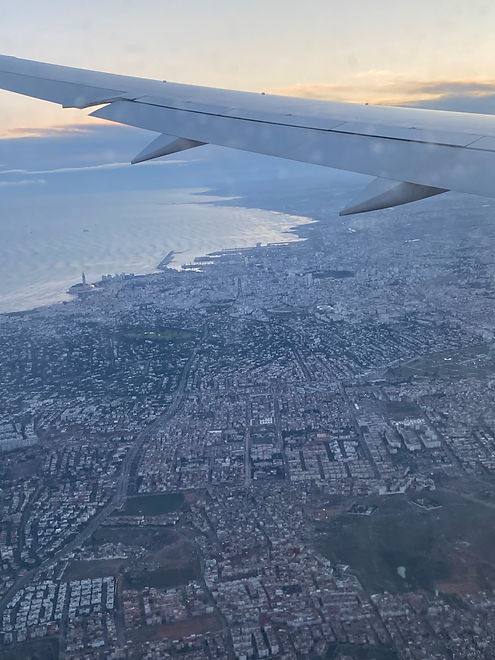

ARRIVED
Mohammed V International Airport in Casablanca
Preparing for (No) Travel: Pockets Full of Gold - Last Post Before Trip Postponed
Admittedly, it has been pretty harrowing preparing for this trip in the last month. Unbridled excitement tends to become apprehension as travel plans change from amorphous designs to a million real tasks that need to be completed. I find that it is life's minutiae that causes me the most stress. Planning entire units, managing multiple classes, and creating guiding questions for my travels, though they all take effort, generally calm me. Filing taxes, dealing with travel agents and hotels, and handing off my classes to a substitute are the 'must-do's' that make me want to run screaming off the grid. Slowly, but for sure surely, it is getting done.
The title refers to the difficult truth that this field experience may be cancelled. As the Coronavirus spreads, it becomes increasingly unclear whether all of our studies and preparation will be for naught. Although WhatsApp is being daily flooded with messages about global pandemic, I have mostly (for better or worse) kept it out of my mind, leaning on my privileged cautious optimism. To my fellow Fulbrighters reading this post, I am sorry if I am seemingly ignoring the threads! I know that in my own life many of the greatest disappointments are truly not so disappointing, at least with all the tragedy in the world. Despite the fact that this adventure may end before it begins, I still feel truly honored, so incredibly lucky, gifted as if "I was born with pockets full of gold" (Tom Waits). Already I have had such an enriching time, meeting so many accomplished educators, and taking a global education class that aligns with my own personal pedagogy, lessons that foster empathy and understanding of all other people are the most vital we can teach our students.
Probably the hardest part of this trip is preparing to leave my partner for a month, especially as we say good-bye to one of our dogs, Rufus (on the left). While this is certainly a sad way to begin this blog, I believe it is necessary to be honest about these events and how it may affect me on my travels. I expect to think about Rufus throughout this trip, and know that as I remember his life, I will want to bring it up here; I believe that traveling is not only about what we see and experience when we're gone, but what we bring with us. Rufus was a truly unique person with a kindness that human beings often lack, a love that could save our world if only fully shared.
First Thoughts on Global Education
One of the main areas of emphasis I see in Global Competency Education is the focus on relevancy to students' lives. The first line in the US News article, "It is necessary and urgent that teachers prepare students to understand the the word in which they live..." makes me think of a difficult moment last year with some students. At the end of every year, the history department has a Teach-in where students come together in groups, design workshops, and teach their teachers and peers about a chosen national and/or global issue. I decided to sit in on a workshop in which students were presenting on the Darfur Genocide in Sudan. While these students clearly spent hours preparing, thinking deeply about these topics, I watched several of their peers looking away or at phones, rolling their eyes, and generally avoiding the topic. I am not willing to assume any motive to this behavior, but it did make me wonder. I wondered why a topic that is so brutal, real, and current wasn't connecting with students. I wondered if the topic was too intense, if American education had somehow told students that they should be more concerned with Brad Pitt and his current romance, one of the topics students were whispering about during the workshop.
Reading the "Teaching for Global Competence" chapter shifted these questions. How might this lesson, though taught by peers, still feel disconnected from students' real, lived experience? What tasks were students asked to do to apply the lesson to their own lives? Did students in this lesson get to see this topic from the perspective of multiple disciplines or was it presented as a "history" lesson? During the reading, I thought much about the idea of relevance or making subjects relevant for students versus the actual practice of it. I think I often see relevance as making material connect to the hyper local of my students' lives, focused on their unique experience as adolescents, Americans, Portlanders, but not taking to time to make material relevant to them as global citizens, connecting their plight to others around the world.
Some questions I considered while reading:
How do I push my struggling students to reach while differentiating for the different academic needs of my students more comfortable in English class? How do I use global education to make material relevant to all students in the class?
How do I make globally competent units that target students outside of honors, IB, and AP classes? How can I still meet the needs of students with IEPS, 504 plans, and those who are in my ELD classes?
How can I provide quality feedback to global competency while continuing to support students in their disciplinary knowledge with student loads near or over 180 students?
Technology In and Outside the Classroom
I've been thinking about the unexpected consequences of technology. The great technological marvels of our time have connected people in ways we once could never imagine, yet we seem to grow increasingly inequitable as a society. More so, for a world with more literacy and available information than ever before, the prevalence of misinformation and the likelihood that people will come to believe deceptions (whether they be accidental falsehoods or deliberate lies) seems as bad as it's ever been. For me, this is not a surprise as I never saw technology leading towards a utopia, the idea that they would bring us all together, now that society had the tools to solve our major problems. In fact, I've grown up fairly suspicious of these advancements for these reasons, seeing technology as a means of alleviating or worsening our problems. In terms of teaching global education, I think about the ways that neither as a community or individuals, we are given any say about the ways and degrees to which these products enter our lives. Apple told us how we should use the Iphone, which did not involve public conversations about how much time is appropriate to spend with them, advice or support for differentiating between accredited journalism versus conspiratorial thinking, nor negotiations about how they would be introduced to our children. For Apple, and all companies making these products, the best use of their technology was the most use. Only now, years later are we beginning to have conversations along with patchwork solutions to problems that probably should have been foreseen. Personally, I want to support my students with their embrace of technology, but I wish for a more seamless use, children using smartphones and the internet to connect with the world, rather than to check out from it. It reminds me of Bryan Stevenson's Tedtalk, which I play for my students at the end of every year. Stevenson asks the audience, one comprised of wealthy elites, to consider that "societies will ultimately not be judged by their technological accomplishments, but by the way we treat those that live at the bottom, the poor, the incarcerated, the in-firmed."
United Nations Sustainable Development Goals (UNSDGs)
I immediately see several places in my curriculum in which I could easily integrate UNSDGs 1, 5, 10, and 15. My school has made racial and gender discrimination and systemic inequity a major focus of our training. In addition, I have made discussing poverty and climate change, especially the ways these two are often woven together, a priority in my curriculum. I have attempted to not only address these issues in the classroom, but also into my own personal practice. How can I teach my students about racial and gender bias, if I am allowing those same biases to penetrate my own personal life? For this reason, I am participating in anti-racist work personally and professionally everyday, understanding that growing up white in a racist society, my own desire to not be seen as racist, makes me particularly susceptible to perpetuating racist tropes, perpetrating harm to my students.
Many of these topics matter to me because I grew up not having to think about them. I grew up white, male, and never having to worry about money. When I began to discover the vast inequity, real cruelty, I never quite stopped being angry. While I am not saying I didn't work hard, for many reasons, probably my own struggles with school for a very long time, I never could understand for what reasons I had these opportunities, these safeties and securities while others did not. Honestly, I do not always understand why I am not more ashamed, why everyone isn't, why we all aren't marching in the streets, furious.
Final Questions:
What steps do I take to ensure I am treating each student fairly, while recognizing the individual difference and need of every student in my class? Which authors do I choose to feature? How am I modeling for my students a person that deeply cares about issues of poverty and climate change?
UNSDGs Lesson Plan Ideas
I want to quickly note some ways that I integrate a few or all of the SDG's into some specific lessons or units. I teach a speculative fiction unit in which students ultimately choose a topic they care about, then exaggerate it to make their own, usually dystopian, short story. By introducing these goals early in the year, you can use them as a means of developing ideas for this project or any unit that asks students to choose a cause or passion.
I suggest thinking about the UNSDGs when considering the Taking Action portion of the Asia Society books. You migh ask: How could I take this project further to connect with people all around the world? How might the students use the stories as a means of creating awareness and mobilization towards a given cause?
In this same above unit, I teach a few Ursula Le Guin stories, one of them "The Ones Who Walk Away From Omelas" a utopian story where an entire city thrives and prospers based on the suffering of one child. I ask students after they read it to tell me where their clothes come from. Without a beat they all say, "Children in other countries." This year, I took this lesson further, asking students to then actually track where their clothes, their everything comes from, to ask them to think about the way we rely on people from around the world, and not always in forms that would make us proud.
Another suggestion is to combine them with a Project-Based Learning Experience or PBL. I created a poetry unit for my students that I wanted to be in large part a PBL experience. I compiled poets, different styles of poetry, prompts, and models for students to create their own short book of poetry. While I was working on this unit before the Fulbright class, it became the perfect opportunity to embrace the UNSDGs and Global Learning, putting more emphasis on students' own control over the project, not only in the creation of the poetry, but what they might want to do with it. It was a great opportunity to guide students to write about issues that matter to them.
Global Learning as Celebrating and Learning As Opposed to Dominating
I want to focus on the illusory conflict or fear presented in Appiah's "Cosmopolitan Patriots." Essentially this article inquires (or pushes back against the idea about) whether considering our place in a global community leads to a form of assimilation and cultural loss. For me, I think he illustrates a philosophy that encourages a global competency in the classroom, one that celebrates the plurality of distinct cultures, while not seeking to dominate. At one point, Appiah speaks about the idea of a "central common culture" as something that an individual wrongly will think is totally shared by the collective. I think another way of framing it might be that many Americans see other people as having cultures while seeing themselves as the embodying the correct way of living. For me, I think embracing globalization in the classroom is a direct attempt at dispelling this notion of supremacy. This reminds me of a documentary that I have shown in my class called "Schooling the World: The White Man's Last Burden", https://schoolingtheworld.org/film/ (Links to an external site.), a film I think about in conjunction with global education. I always like showing my students this one because it challenges our very conceptions of western education and asks students to consider other means of educating our children. More so, it challenges any belief that our way is the best way. The film notes that many people are not served by these education models, even many, arguably the majority, of American students are not given the skills needed to succeed in our world. The film compares our means of educating children to that of the Ladakh in the Northern Indian Himalayas. It does not take long watching the film for students to ask why we don't base our schools after these communities, ones that stay connected to family and history, work in concert with their environment, and value happiness as an ultimate goal.
Questions:
In what ways can I connect students to the rest of the world, making sure to avoid perpetuating feelings of superiority? How can I teach students that our way of being is only one possible choice among an infinite multitudes of equally valuable choices?
Past Issues with Technology and Why I Appreciate the SAMR Model
I have struggled with the way digital literacy and technology generally have been referenced and used in schools where I've both taught and applied. I remember interviews, now awhile ago, in which I would get the inevitable, "How should teachers integrate technology into the classroom?" and realized that they were actually asking. "No really, how? We have no idea." While I have taught in rooms with SMARTboards, specifically my first year as an ELD teacher, no one ever explained how to use it nor offer ideas for how I might integrate it into my lesson. It is why I appreciate the sentiment expressed in a Kappan article that, "Teachers also need instruction in how to integrate these new digital strategies into their classrooms and time to plan with colleagues in other subjects and grade levels to ensure integration across the curriculum." The Fulbright coursework provided a much clearer path forward; what has allowed me to post a list of digital resources with specific ideas for integrating them into the classroom. While I am still learning, and consider myself only beginning to see myself as digitally literate, I have come a long way, able to move to online learning with far more ease than others. After watching the film, "The World is as Big or Small as You Make it" (featured on the Global Digital Resoures and Organizations Page) I've been thinking, "We have ipads for our ELD students; we could do this tomorrow!" I do wish that we had more time to plan, more instruction in our schools about learning better ways of using technology and teaching literacy. It makes a lot of sense to me that so many teachers rely on the "checklist." Maybe worse in my own teaching is I am unsure how much I personally directly teach digital literacy in the class. The line from the reading, "Although we face a digital challenge, educators have relied on a distinctly analog approach to solving it," admittedly speaks to my own reluctance at times to embrace technology, the same way I often approach digital literacy in the classroom.
Unit Plans
While this may not be particularly insightful, one of the biggest ah-ha's from revising on my unit plan is simply that I am energized by the work. I certainly put in a ton of time planning individual lessons, thinking about my units and scope of the year, reading and rereading and annotating texts to feel confident in my role as a teacher (and everything else we do!), at some point after graduate school, I stopped writing unit plans. The transition came from a feeling that they weren't helping me much with the unit as it became almost a list of the individual objectives, skills, devices, and vocabulary that were already present in the process it took me to design daily lessons. When I decided to hold off and create a plan for a poetry unit using the global competency tools, I found myself absolutely ecstatic about the project, exactly as a teacher should be about their curriculum. Through this process, I may have become a unit plan convert! This is due not only to the lenses offered by the global competency curriculum, but also being forced to submit for review and revision. The format of the unit plan organizer, asking me to think about the different aspects of the course, has been invaluable to reimagining this project, in the poets I've chosen, in the scope of what I expect students can accomplish, and in ultimately transforming this project from poetry writing for a class to activism for a better world!
Last Thoughts on Fulbright Class and Intersection with Anti-Racist Teaching
While I began this course feeling a bit overwhelmed, especially about the focus on technology, I moved to a place of comfort as the vast amounts of information presented at the beginning of the course became supplemented with many clear examples of implementing global thinking curriculum into our classrooms, schools, districts, and communities. What remains most impactful is that Global Thinking is not simply a set of resources, not required curriculum, nor a push to use a certain set of buzzwords, instead a re-imagining of the who we are as human beings. It's reminiscent of the Anti-racist movement (among many more) that declares if we are not actively dismantling racism, questioning our own thoughts, actions (or nonaction), and behaviors, we are just perpetuating the goals of a racist society. Much like this idea, Global Thinking asks us to "investigate" bias in our thinking, "recognize" the ways our teaching might be narrow as well as ways we can make our teaching more inviting, more student oriented, then "communicate" this insight to "take action" for a better world. In short, if we truly wish for a better world, then we cannot do nothing. Otherwise, we are a part of the current world.
I really love the UN SDG's as lens to introduce, teach, reinforce, and create action around global thinking. The week that focused on the framework for implementing technology in the class was extremely helpful. The simplicity of considering whether or not technology acts as a substitution versus a tool that will drastically change students' learning addressed a long time concern of mine. I believe that much of the technology I had seen was either not changing much for the class or a lack of training for technology that could have great impact.
I think another evolution has to do with planning. I have always spent a ton of time planning, putting together units through carefully constructed lesson plans along a few central themes, topics, and literary devices or techniques. I had been working on my poetry unit in this way over the summer, and upon being asked to create a unit plan through this lens not only focused the unit, but has given me a new excitement to teach it. I am excited to use the global thinking template to create plans for the rest of my units.
Final questions: Where are there still blind-spots in my teaching and curriculum? Where could I still do better? How might I find people immersed in global thinking to observe my classes, coordinate curriculum, and advocate on the school, district, state, and federal level?